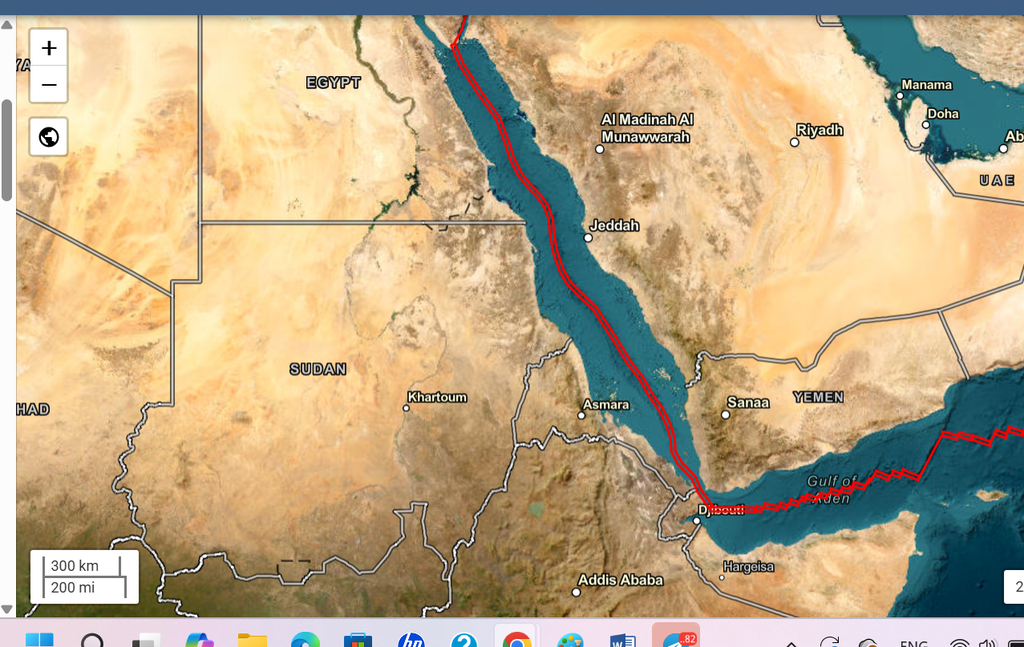
Seismic monitoring networks continue to record ongoing low-to-moderate earthquake activity across the Red Sea rift system, impacting coastal regions of Eritrea, western Saudi Arabia, and western Yemen. (Periodic Post 2)
Driven by active seafloor spreading and mantle plume interactions along the Red Sea Rift axis, tectonic stress along the coastal margins of the southern Red Sea basin remains a primary focal point for regional geodynamics.
1. Tectonic & Structural Framework
The Red Sea Rift is a oceanic-continental extension zone separating the African (Nubian) Plate from the Arabian Plate. Key regional dynamics include:
- Rift Axis Spreading: Seafloor spreading along the central axial trough occurs at approximately 1.0 to 1.5 cm per year, driving transform faulting and localized magma injection.
- Danki Lowlands & Southern Red Sea Swarms: Intermittent volcano-tectonic swarms extend from the Danakil Depression northwards into the Hawakil Archipelago (Eritrea) and Farasan Islands sector.
- Western Arabian Escarpment: Fault structures along the coastal Tihama plains and interior volcanic fields (Harrats) experience periodic crustal stress adjustments.
2. Recent Regional Seismic Activity Log
Below is a summary of recent seismic events and localized tremors recorded in the Red Sea basin and adjacent coastal margins:
| Date | Mag (Mw) | Depth | Location / Zone Focus | Tectonic Context |
|---|---|---|---|---|
| Sep 27, 2026 | 3.3 | 10 km | Hayfan Area, Taiz Governorate, Yemen | Crustal fault relaxation along the southern Red Sea/Afar continental boundary. |
| Sep 10, 2026 | 3.1 | 10 km | Lahij–Taiz Border, Western Yemen (81 km S of Taiz) | Shallow intraplate tremor along the Tihama coastal flank. |
| Sep 08, 2026 | 3.9 | 10 km | Offshore Red Sea / 70 km SE of Mocha, Yemen | Transform fracture release along the Bab-el-Mandeb approach. |
| Aug 26, 2026 | 4.6 | 10 km | Offshore Red Sea, Tokar Axis (Sudan/Eritrea border) | Moderate axial rift extensional event. |
| Nov 23, 2025 | 5.0 | 10 km | 128 km NE of Hawakil Island, Northern Red Sea, Eritrea | Moderate offshore rift-axis earthquake in central Eritrean waters. |
3. Risk Assessment & Hazard Impact
- Coastal Land Shaking: The majority of events occur offshore along the axial trough, resulting in weak or unfelt shaking (MMI II–III) across coastal settlements such as Massawa (Eritrea), Jazan (Saudi Arabia), and Mocha/Hodeidah (Yemen).
- Volcanic & Volcanic-Field Interactions: Seismic swarms along the southern Red Sea boundary frequently correlate with deep magmatic intrusions into volcanic fields (such as Harrat ash-Shaam/Al-Birk in Saudi Arabia or the Afar/Eritrean rift segments).
- Tsunami Risk: Standard strike-slip and normal extensional faulting along the Red Sea axis produce negligible vertical seafloor displacement, maintaining a low tsunami threat profile across the coastal regions.