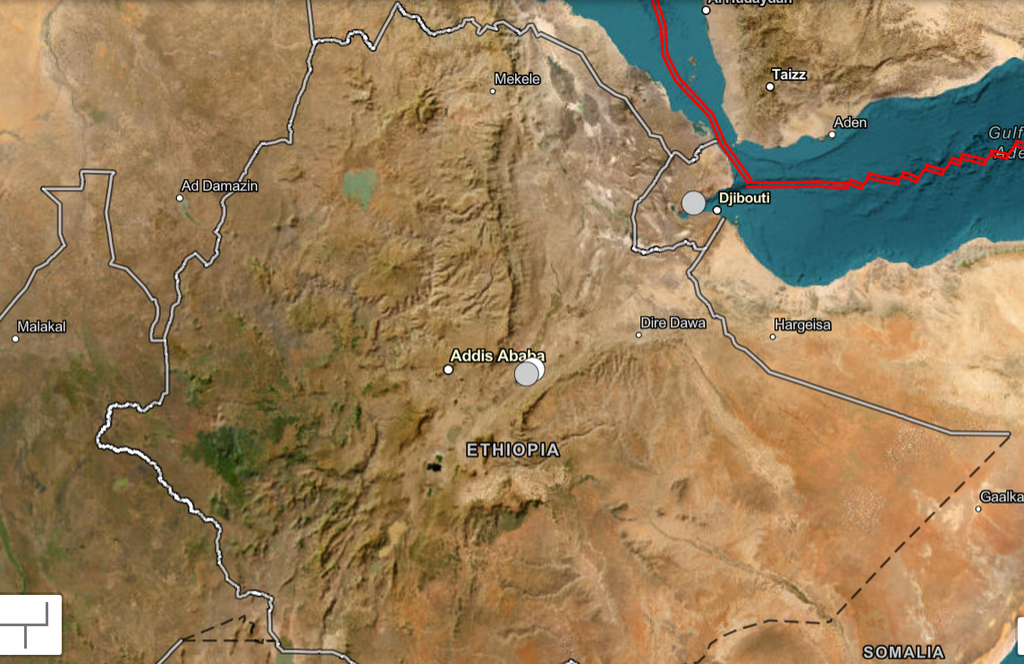
Seismic monitoring networks (USGS, EMSC) continue to record significant volcano-tectonic activity across the Ethiopian landmass, driven by active extension along the Main Ethiopian Rift (MER) and the Afar Depression.(Periodic Post 2)
As the Nubian and Somali sub-plates separate, stress transfer along the Wonji Fault Belt (WFB) and border escarpments has generated persistent earthquake swarms, shallow crustal faulting, and magma-induced surface fissuring across the Oromia, Afar, Tigray, and Amhara regions.
1. Tectonic Framework: Rift Segments & Deformation Zones
Seismicity across the Ethiopian landmass is divided into three distinct geodynamic sectors:
- The Afar Depression (Triple Junction): The focal point where the Red Sea Rift, Gulf of Aden Ridge, and Main Ethiopian Rift converge. Seismicity here is dominated by shallow dike intrusions, volcano-tectonic swarms, and extensional normal faulting.
- Northern & Central Main Ethiopian Rift (MER): Extending through the Awash Basin, Lake Valley (Ziway, Langano, Hawassa), and the Wonji Fault Belt. Characterized by high strain localization, geothermal activity, and shallow earthquakes (≤ 10–15 km depth).
- Rift Margins & Plateau Escarpments: Western (Amhara/Tigray) and Eastern (Hararghe/Bale) boundary faults that accommodate flexural stress and intraplate strain adjustments.
2. Expanded Seismic Activity Log (Whole Ethiopian Landmass)
Below is an updated summary of major reviewed earthquakes and swarm events recorded across the Main Ethiopian Rift, Afar Depression, and Ethiopian interior boundaries:
| Date | Mag (Mw) | Depth | Epicenter / Region | Tectonic & Geodynamic Context |
|---|---|---|---|---|
| Sep 16, 2026 | 4.5 | 10 km | 6 km NW of Awash, Afar / MER Border | Shallow crustal release along the active Awash-Fentale rift segment. |
| Jun 11, 2026 | 4.6 | 10 km | 132 km NE of Addis Ababa (Fentale / Awash Sector) | Normal faulting release along the Wonji Fault Belt. |
| May 14, 2026 | 4.5 | 10 km | 91 km NE of Adama (Nazret), Oromia | Extension along the central MER fault structures. |
| May 11, 2026 | 4.7 | 10 km | 136 km SW of Arba Minch, SNNPR / Southern Rift | Intermittent intraplate tension along the Southern MER flank. |
| Feb 04, 2026 | 4.6 | 10 km | 73 km NE of Adama (Nazret), Oromia | Shallow earthquake on the MER-Afar transitional margin. |
| Jan 07, 2026 | 4.8 | 10 km | 184 km E of Addis Ababa (Awash Basin) | Tectonic tremor along the active Awash rift valley axis. |
| Nov 23, 2025 | 5.5 | 10 km | 130 km E of Mek’ele, Tigray / Afar Margin | Moderate structural collapse event along the northern Afar border escarpment. |
| Oct 11, 2025 | 5.6 | 10 km | Northern Afar Depression / Tendaho Graben | Extensional rift event tied to active magmatic spreading. |
| Feb 14, 2025 | 5.9 | 25 km | 83 km ENE of Adama (Metehara / Fentale complex) | Major regional shock; highest magnitude event in Ethiopia during the 2025–2026 cycle. |
| Jan 03–04, 2025 | 5.8 | 10 km | 45 km NNE of Awash (Fentale–Dofen Volcanic Segment) | Main shock of a massive swarm (>170 events) driving surface cracking. |
3. Risk Assessment & Infrastructure Vulnerability
- Transportation & Logistics Belts: The concentration of shallow tremors along the Awash–Metehara corridor poses recurring hazards to linear infrastructure, including ground displacement across the Addis Ababa–Djibouti railway and highway systems.
- Hydrological & Agricultural Impact: Magmatic fissuring in the Awash River Basin regularly leads to stream rerouting, altered thermal spring flow, and agricultural field cracking.
- Urban Shaking & Masonry Risks: Because depth profiles throughout the MER and Afar are shallow ($\le 10\text{ km}$), moderate earthquakes ($M_w\text{ 4.5–5.9}$) generate sharp ground motion (MMI VI–VIII) in towns such as Awash, Metehara, Adama, and Semera.