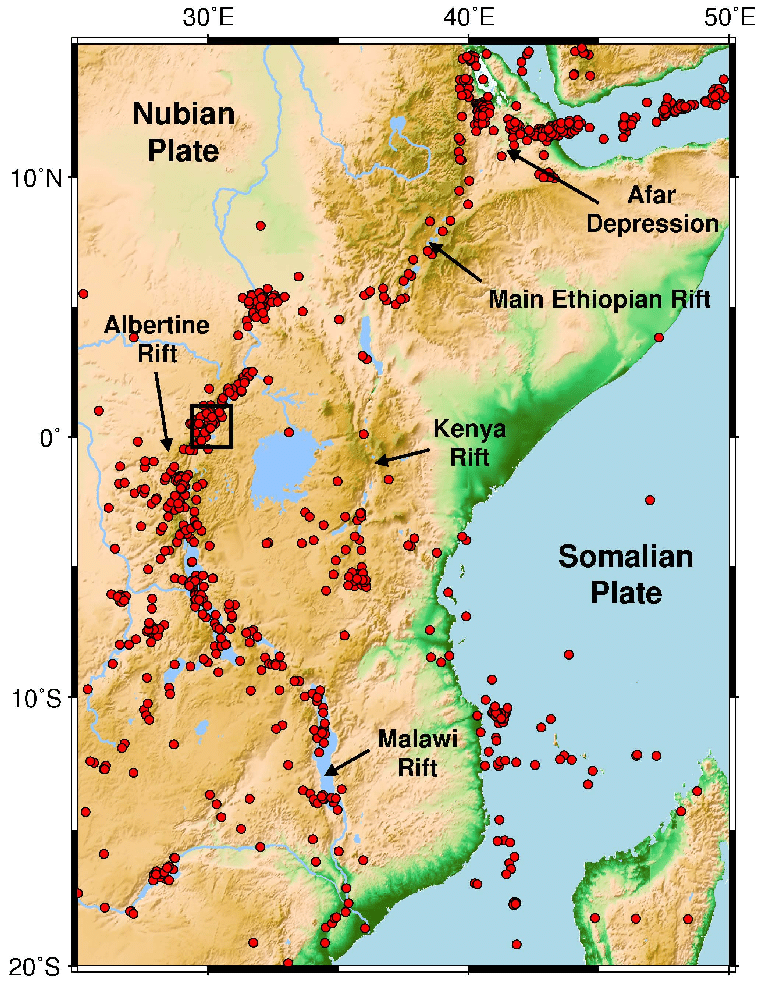
The Main Ethiopian Rift (MER) and the Afar Depression remain among the most seismically active rift systems globally. Over recent months, a series of moderate, shallow earthquakes have recorded along active fault segments connecting eastern Oromia and southern Afar. Below is an in-depth summary of recent seismic events, their localized structural settings, and tectonic drivers.
Summary of Recent Recorded Seismic Events
| Date | Magnitude | Depth | Epicenter Location & Regional Impact |
|---|---|---|---|
| Sept 16, 2026 | M 4.5 | 10 km | ~6 km NW of Awash / 27 km NE of Metahara (Afar/Oromia border). Tremors were lightly felt in Awash town and nearby agricultural settlements along the Awash River. |
| Aug 10, 2026 | M 4.6 | 10 km | ~19 km SE of Metahara / 23 km from Awash. Caused noticeable shaking across parts of eastern Oromia and the Fantale volcanic domain. |
| Jul 7, 2026 | M 4.4 | 10 km | ~10 km East of Awash, Afar Region. Centered along shallow marginal faults of the southern Afar boundary. |
| Jun 25, 2026 | M 4.6 | 10 km | ~21 km East of Debre Birhan. Situated along the steep western rift escarpment margin where Western Ethiopian Plateau rocks meet the rift floor. |
| May 22, 2026 | M 4.8 | 10 km | ~11 km NE of Metahara. Moderate tremor near Lake Beseka and Mount Fantale caldera complex. |
Geological & Structural Analysis
1. The Awash & Metahara Rift Segment
The concentration of events around Awash and Metahara (M 4.5 to M 4.8) highlights active extension along the Wonji Fault Belt (WFB). This narrow belt of en-echelon normal faults accommodates most of the modern plate motion within the rift floor. Faulting in this area is frequently accompanied by minor dike intrusions and volcanic-tectonic activity linked to nearby geothermal systems such as Mount Fantale and Lake Beseka.
2. Rift Escarpment Seismicity (Debre Birhan Sector)
The June 25 event (M 4.6) east of Debre Birhan reflects seismic strain along the Western Marginal Fault System. Unlike events on the flat rift floor, escarpment earthquakes occur along major border faults that define the sharp topographic boundary between the high Central Plateau (elevations >2,500 m) and the rift valley floor.
3. Depth & Shaking Characteristics
All recorded events occurred at shallow depths (~10 km). In continental rift settings like Ethiopia, shallow hypocenters mean that even moderate magnitudes ($M 4.0 – 4.8$) can produce sharp localized ground shaking felt within a 30 to 50 km radius of the epicenter.
Key Takeaways for Regional Hazard Monitoring
- Continuous Crustal Extension: The Somalian plate continues to pull away from the Nubian plate at a rate of approximately 2–5 mm/year along the Main Ethiopian Rift.
- Magmatic-Tectonic Interaction: Earthquakes in the Metahara-Awash corridor are closely monitored due to their proximity to active geothermal fields, major transport infrastructure (Addis-Djibouti corridor), and volcanic centers.
- Micro-seismicity Swarms: Larger events ($M > 4.5$) are often accompanied by smaller background micro-earthquakes ($M < 3.0$) that indicate ongoing stress release along faults.